
Explore the link between Afrobeats and modernism
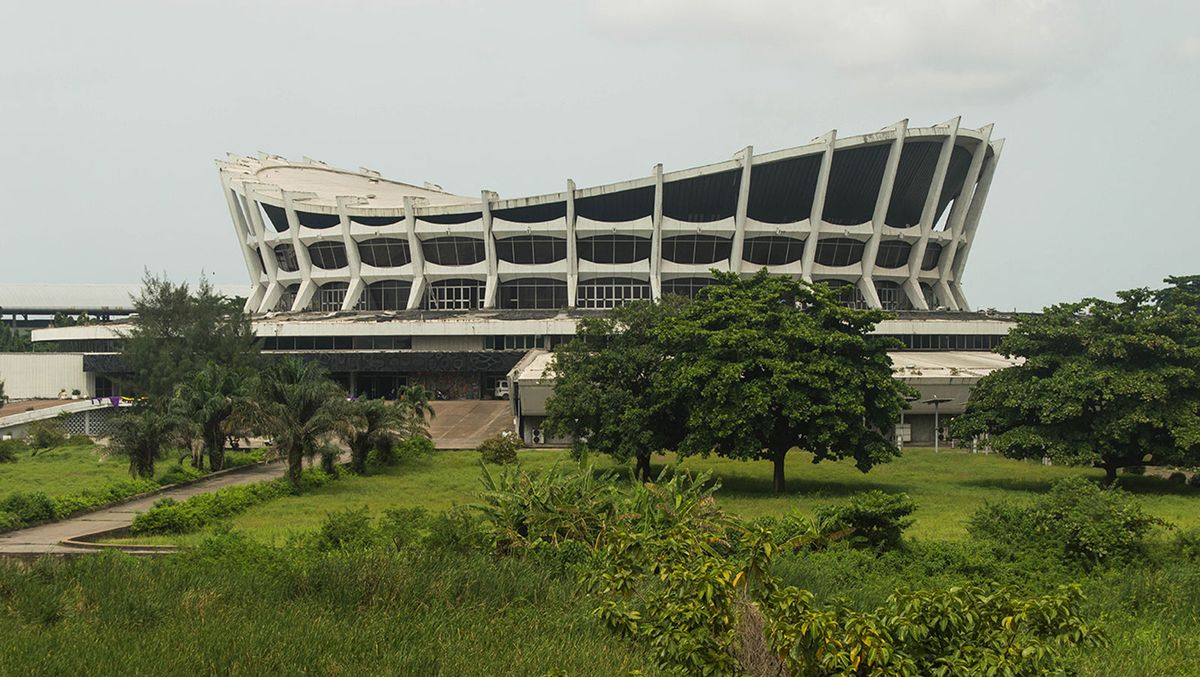

In the mid to late 1950s, the wave of independence swept across West Africa, and along with it, a search for new meaning for its freshly created nation-states. At the same time, in the region’s built environment, modernist architecture took root, reinterpreted to adapt to the climate; and by the 1960s, it had become the poster image of independence and Pan-Africanism (as discussed in London’s V&A’s recently opened exhibition ‘Tropical Modernism: Architecture and Independence’).
Simultaneously, musical expression was at an all-time high, especially with the introduction of a new genre of music, Afrobeat, which, like tropical modernism, synthesised foreign influences into a new cohesive and contextual whole. Its purveyor, Fela Kuti, was of Nigerian descent. His style crystallised in musical form a zeitgeist in the region, melding infectious percussion and wind instruments with critical social and political commentary.

(Image credit: Olajide Ayeni)
Afrobeats and modernism: a parallel history
In this context, tropical modernism came to be identified as a tool of power, and among those leading this charge was politician Kwame Nkrumah, the first prime minister of Ghana, who saw architecture as an image-making tool that could become a beacon for a free Africa.
At the same time, in Nigeria, military rule meant that many of the bigger commissioned buildings became sites of immense corruption, eventually suffering from arson and mismanagement. To this day, some remain abandoned. While architecture stood as a political tool of liberation, music through Fela’s Afrobeat stood as a check and a voice of the many against the few who had seized power. Contextually, these two art forms became linked as elements of representation while opposing each other.

Trade Fair Complex, Lagos
(Image credit: Olajide Ayeni)
Still, there are hardly any explicit and official links between local music and the regional form that modernism took in Nigeria – unlike the ‘musique concrète’ and its spatial expressions of IIannis Xenakis in his well-documented Philips Pavilion (in collaboration with Le Corbusier).
Instead, a relationship seems to be brewing retrospectively between these now largely abandoned concrete structures and Afrobeats, a sub-culture and genre that evolved from Afrobeat, with the former becoming a site for reclamation and artistic expression. Once symbols of a newly liberated country, modernist buildings are now being transformed into a stage, and sets for creativity, used especially by some of Afrobeats’ biggest contemporary stars, offering appealing visual backdrops for the pictures their music videos paint.

Trade Fair Complex, Lagos
(Image credit: Olajide Ayeni)
The Trade Fair Complex (1977), designed by Yugoslav architect Zoran Bojovic as part of Energoprojekt’s mission in Nigeria, and the National Theatre (1976), designed and built by Techno Expostroy, a Bulgarian construction firm, were erected under military rule and to coincide with the Festival of Arts and Culture (FESTAC) in 1977.
The National Theatre featured on stage in a Grammy performance by award-winning Nigerian singer and songwriter Burna Boy. The building’s stained glass murals highlighted in the performance were done by a collection of artists, including Yusuf Grillo and Erahbor Emokpae. The latter worked closely with the architects and was commissioned to make the friezes that adorn the lower parapet of the theatre.

Trade Fair Complex, Lagos
(Image credit: Olajide Ayeni)
Burna Boy’s 2021 Grammy set’s connection with the ill-kept building couldn’t have been more timely, as the following year plans were hastened to renovate the structure (a restoration that remains ongoing).
The theatre is also a backdrop in Nigerian musician Wizkid’s video for his single ‘IDK’. The performance here is set against civic and cultural infrastructure. Although no official links were made public between the song and its setting, it hints that these buildings retain greater value in their current state than the new architecture springing up in the country today.

(Image credit: Olajide Ayeni)
Meanwhile, the Trade Fair Complex with its intricately welded bronze-plated screen has been featured in videos by Burna Boy, Humblesmith, and Prettyboy D-O.
The rooftop of the Old Barclays Bank building and the Shell building in Lagos, designed by Walker, Harwood and Cranswick, and Design Group Nigeria, respectively, have also played host to a plethora of artists seeking the incredible concrete architecture of Lagos Marina and its impressive brise-soleils for their backdrop to craft a sense place. Through these acts, the artists reclaim these sites from abandonment and activate them, setting a precedent and a call to action.

(Image credit: Olajide Ayeni)
In Nigeria, many examples of this regional modernism lay abandoned; at the same time, it is currently arguably a big export from the country in architectural terms, with the world looking to once again learn from the climate-conscious solutions of this style. Afrobeats is equally a local genre with worldwide appeal and a significant export in the music world.
Through Afrobeats, a case is being made, albeit latent, for what is worth preserving while simultaneously questioning predetermined and alternative uses that these buildings may have today. Lagos is filled with such examples, many of which sadly, face demolition threats. Artists’ activations pose the question: might these sites be catalysts for cultural development, especially given their long history and collaboration with the creatives that birthed them?
Crédito: Link de origem

- Advertisement -

Comentários estão fechados.