
Tropical New Brunswick home to Dr. Seuss-like tree from around 350 million years ago – Winnipeg Free Press
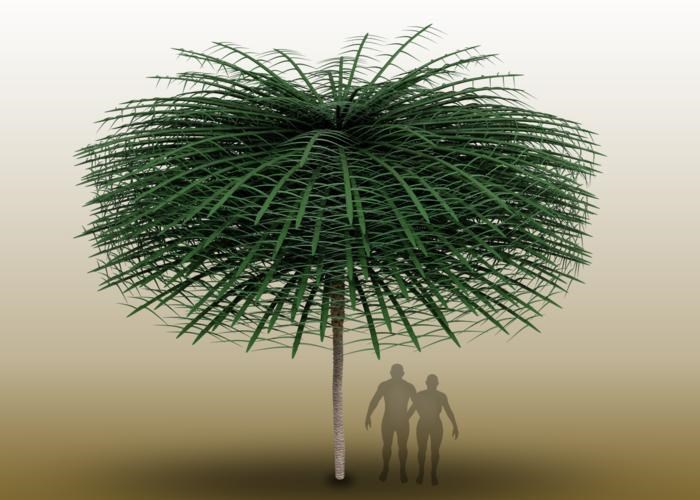

FREDERICTON – An enigmatic fossil uncovered seven years ago in a New Brunswick quarry has been found to reveal an extinct tree with a narrow trunk and a top like a pompom, a remnant from a time before dinosaurs walked the Earth.
A paper published last week in the journal Current Biology opens a window into a world of plants during the Carboniferous period, when New Brunswick was a tropical land within 10 degrees of the equator.
Matt Stimson, one of the authors of the study, who works at the New Brunswick Museum in Saint John, said the plant is from a time of flux when flora and fauna were starting to adapt and diversify on land.
*MANDATORY CREDIT *
The tree was a “failed experiment of evolution” and didn’t survive, but he said it helps researchers understand the complexity of forests. And finding an intact fossilized tree is unusual, he added.
“This is very rare — and by very rare, only a few have ever been found in … the whole of the fossil record,” he said. “Not just at this time, but anywhere in geological time, where the stem, the branches, the leaves are attached and complete.”
The fossil was found in 2017 in a quarry in Norton, N.B., about 80 kilometres southeast of Fredericton. Before publishing, the researchers had to verify their discovery and make sure the science was accurate and that they had actually found something brand new, he said.
“Ultimately science takes time. Big claims require big proof.”
Stimson said he was doing summer fieldwork with Olivia King, a graduate student at Saint Mary’s University, when they saw a large stone with seeming discoloration, and began to gently excavate around it. The more than 300-million-year-old fossil preserved in a two-tonne boulder then began to reveal itself — a spiral configuration of leaves attached to a trunk.
The area where the fossil was found would have been a lake bed, sitting on a fault line, back when the tree grew. Stimson said an earthquake tore down the tree and it was buried in layers of sand.
Adrian Park, a co-author of the paper who works at the New Brunswick Department of Natural Resources, said another unique thing about the fossil is that it was preserved in a 3D-like state.
“Usually, a tree falls over and it gets buried in the mud. That mud compacts into a rock, and then in the process, fossils are just pressed down on a single layer … on a flat surface,” he said.
“Whereas in this case, the branches actually penetrate through the layers. And the layers themselves are very contorted. … The sand very quickly poured in from the top and preserved it in three dimensions.”
The tree, named Sanfordiacaulis densifolia after the quarry where it was found, had a 16-centimetre soft trunk, stood three metres tall and had a “bottle brush” canopy of 250 leaves, each measuring about 1.75 metres, he said.
Stimson called it more of a “giant plant” than a tree.
“They were like giant ferns or very odd Dr. Seuss-like trees, very different than anything today,” he said, referring to illustrations by the beloved children’s book author.
“The branches or the leaves come directly off the stem and they are in a spiral pattern coming out horizontally from the tree … in a very dense fashion.”

Stimson said that structure would have allowed the tree to capture as much sunlight as possible after it travelled through the forest’s upper and middle canopies to the ground level where smaller shrubbery type plants of its kind sat.
This plant tells us what the forest was like back then, he said. There are not many fossils of plants from this period on Earth, known as Romer’s gap. Although this plant was a failed experiment, those that have survived are ancestors to the forests today but in a much different form, he added. The club mosses, for instance, he said, were up to 30 metres in height during the early Carboniferous period but now measure just a few centimetres.
The Carboniferous period when these trees were found was also a time of transition with swamps teeming with life, including ferns with spores, millipedes and giant, salamander-like creatures that were starting to crawl out of the water, he said.
“These early forests harboured and provided a home for the first amphibians that made the transition from water to land. You certainly wouldn’t want to go swimming in the waters,” Stimson said. “There were giant sea scorpions, very big fish with teeth … millipedes and other types of bugs were starting to crawl on land.”
This report by The Canadian Press was first published Feb. 5, 2024.
Crédito: Link de origem

- Advertisement -

Comentários estão fechados.